This article thanks BA4DL, BA5CW, and BG7JAF for their assistance, and expresses gratitude to BI4KUF for their support and participation.
As a DX enthusiast, the low band is also an important and attractive band for DXing. However, in the eyes of most DXers, the 160m and 80m bands are difficult to access: firstly, they require large antennas; secondly, they are limited by the propagation characteristics of the low band; and finally, it's impossible to achieve good reception due to the high level of noise in urban areas.
However, once you experience a successful DX on the 80m or 160m band, you'll quickly become hooked.
Of course, the author's love for low frequencies began when I was still a BCL amateur radio operator, spending every day using a PL990 to make medium-wave DX contacts. In the early morning of winter in 2020, I successfully contacted RFE/RL (Radio Free Europe/Radio Liberty), which was transmitting from Lithuania to Russia, with an output power of 50kW, and obtained a valuable QSL card. From then on, my passion for low frequencies has only grown stronger.
So, let's get straight to the point and discuss how to achieve DX (long-distance communication) in the low band.
Antenna
One of the most challenging aspects of operating on the 160m/80m bands is antenna selection. The large size, wide footprint, and high height requirements of antennas limit the exploration of these bands by many amateur radio operators. This article will introduce several common antennas used on the 160m/80m bands.
I. Small Ring Antenna
As is well known, small loop antennas generally have a low power tolerance. This is because the capacitor plates in a small loop antenna are under high voltage during transmission, and capacitors that can withstand high voltages are typically expensive and difficult to obtain, making small loop antennas a common choice for QRP (low-power) communication.(With a small loop antenna having such a high Q value, wouldn't using a high-power amplifier cause sparks and potentially start a fire?)
It is clear that QRP on 160m/80m is not a good choice, so we generally prefer to use small loops as receiving antennas. Small loop antennas have some directional properties, which makes them more suitable as receiving antennas.
The corresponding value for a circular antenna is the cosine of the angle between its circular face and the direction of the electromagnetic wave, rather than the whip antenna having omnidirectional coverage. This is similar to the directional pattern of an octagonal antenna, which has sharp null points perpendicular to the circular face, making the circular antenna directional.
Considering the limited space available for antenna installation in urban environments, it is possible to use active small loop antennas instead of passive ones. While active small loop antennas can increase receiving sensitivity to some extent while reducing their size, they also tend to amplify background noise. The following methods may help reduce background noise:
1. The antenna should be installed in a relatively open area, avoiding factories, stations, high-voltage power lines, and large-scale base stations.
2. Ground the antenna properly; do not connect it to the same ground as the lighting power line!
3. Minimize the length of the feeder cable and ensure that there are no interference sources near the feeder cable.
4. Install inductors on various power cables
II. DP Antenna
During my conversation with BI4KUF, I don't believe that the EFHW (End-Fed Half-Wave Antenna, commonly known as an end-fed antenna) is a dipole antenna. Instead, I find it to be more accurately described as a theoretical approximation of a dipole, but one that doesn't actually function as a dipole in practical applications.
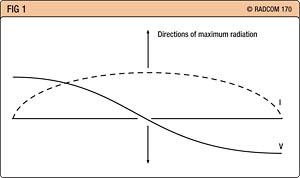
The graph above shows the voltage-current waveform when a dipole is operating. It's clear that at the center point, the dipole's voltage is at its minimum, while the current is at its maximum. This allows for impedance matching and efficient power transfer.
However, it's clear that this article isn't intended to explain the principles of antennas. My understanding of antenna principles is limited.
If we disregard the terminal effects of the antenna, then theoretically, a full-sized dipole operating at 80 MHz should have a length of:
l = 42.9 m (to three significant figures)
However, if the pre-shortening effect is taken into account, then a dipole operating at 80m can be approximately calculated as having a length of:
l = 143 / 3.5 = 40.9 m (to three significant figures)
The lengths provided above should only be considered as approximate values. Therefore, when actually constructing the antenna, remember to leave a little extra length on the wire, and then adjust the end of the antenna to the calculated theoretical length for fine-tuning.
When installing, the dipole is typically mounted as shown in the diagram below. Two soft lines are used to stretch the dipole completely straight and raise it to a certain height (typically, a dipole of 1/2 wavelength can achieve DX communication; if you want NVIS effects, it's usually raised to 1/4-1/10 wavelengths).
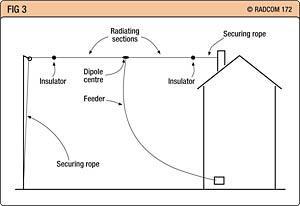
Therefore, within a city, it's generally possible to install a dipole antenna between two buildings (ideally high-rise buildings with at least 18 floors).
Therefore, in this context, I would like to discuss the coaxial feed antenna. In practice, the mounting method of a coaxial feed antenna and a dipole is exactly the same. However, the only difference between a coaxial feed antenna and a dipole is that a coaxial feed antenna is an unbalanced antenna, while a dipole is a symmetrical balanced antenna. Therefore, a coaxial feed antenna typically uses different types of un-un connectors, such as 4:1, 49:1, or 64:1. If the grounding of the un-un connector is not perfect, it can cause very serious EMC interference (common mode current), which can interfere with the USB serial cable and even cause the transmit button to be affected (I have been affected several times).
III. GP
Like BI4KUF, I am very interested in GP antennas. This is due not only to their excellent performance at high frequencies (DX), but also because they are relatively easy to install (typically requiring just a ground plane, grounding wire, and antenna mast). For example, models like the MA-12/AV680 can be easily installed on a mast.
However, it is clear that building full-sized GP antennas on the 80m and 160m bands is not feasible. A full-sized 80m GP antenna would be approximately 20 meters tall, while a full-sized 160m GP antenna would be around 40 meters tall. Finding such large antennas and addressing the lightning/wind protection issues in existing urban environments are clearly unrealistic.
To address this issue, we can consider adding a gain to the GP. The following image shows BA5CW's ranking of various GPs from highest to lowest efficiency (from left to right, the efficiency decreases sequentially).
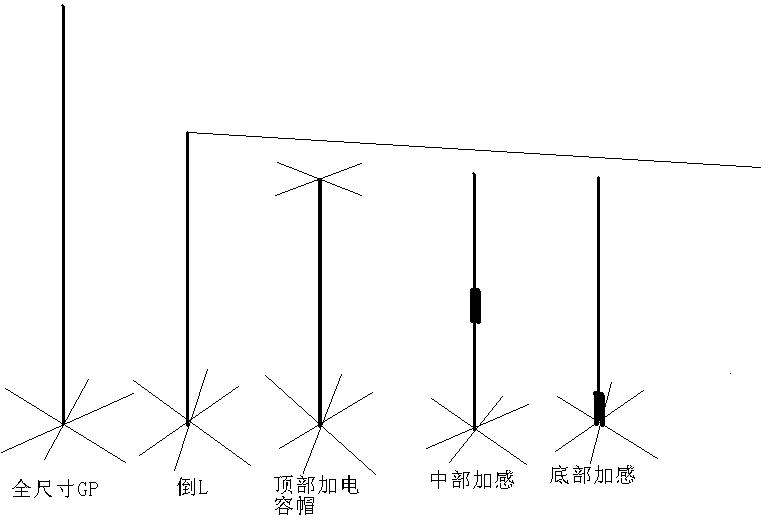
Generally, we do not recommend that the actual electrical height of the antenna be less than 50% of the full-size dimensions. However, it is clear from the following methods that an actual electrical height below 60% of the full size results in a significant decrease in efficiency. In the worst case, an 80m FT8 antenna will not reach outside the country (I have tried a 100W+ bottom-loaded GP antenna, but FT8 only reaches the coastal areas of Japan's Kanto region, and the signal quality is poor, with limited DXCC coverage).
Therefore!
Us!
Take action!
A variation of GP!
Turn the L-shaped antenna!
The inverted L antenna is a common type used by many contest stations. They offer good performance and have relatively low site height requirements, such as BY5CD/BY5EA, or the 2015 mulanDXC Huizhou annual event, which primarily used inverted L antennas or stacked inverted L antennas.(BH6BEZ)I also used a long-wire antenna (height 30m) at the CQ WPX SSB event this year, and achieved good results on the 160m/80m bands (achieved a personal best on 160m SSB with LY0UKR of Lithuania, and completed 33 QSOs on 80m, although I unfortunately forgot to set up my station).

Actually, I had planned to display a few simulated diagrams of the 160m inverted L antenna created by BA4DL, but unfortunately, a few days before...IdiotI have cleared the WeChat chat history, so I can only find the following four simulated images ( ).


IV. Yagi antenna
Using a Yagi antenna on the 80m/160m band to DX appears to be a good option, but they are too large and difficult to rotate (see, for example, OH8X's 100m high 3-element 160m Yagi, and 7J4AAL's 80m 5-element Yagi).
So this section of water has passed through ( )
Finally, let's look at a chart showing the usage statistics for each station on the 160m band, specifically demonstrating their ability to achieve at least 225 DXCC contacts.

As shown in the diagram, it is clear that the DX performance of an inverted L antenna on a 160m band is only slightly better than a vertical antenna. Therefore, when operating in the ground wave band for DX, it is best to use a Vertical/Inverted L antenna.
Practical application
Generally, I prefer CW/FT8 for low-band DX. Based on the early and late gray lines, in summer, the gray line starts around 7 or 8 AM, and 80m is opened to Japan from 4 PM onwards (I usually use the signal strength of the JMH coastal station on 80m to determine whether low-band communication with JA is open), until 5:30 AM the next day. Specifically, the period between 6 PM and 7 PM is particularly good for South American/North American propagation, and today I(2024/06/15)Around 7:00 PM, I completed a CW QSO with NC2W on the 80m band (RST 579, SNT 599). The period from 3:30 AM to 5:00 AM is the European window on 80m, and during this time there will be a large number of European pileups. Earlier in the day, there will also be activity towards Africa (During my A8OK expedition to Liberia in early April, I completed two 80m CW QSOs around 3:30 AM and a 160m FT8 QSO around 4:00 AM).
Once I had a good understanding of local communication methods, making DX (long-distance radio contacts) became much easier. As of now,(2024/06/16), 160m has completed 20 DXCC, and 80m has completed 72 DXCC (These are data from before May of this year, when LoTW discontinued operation on these bands, and do not include statistics for other DXCC contacts made after that date).
However, no matter what, DX is not as good as Dance-Moe DX!
Okay, go to the duty station.


 闽ICP备2021006864号-7
 闽公网安备35020602002794号