Preface: This article is simply a summary of my personal experiences and insights while working with CW Tonglian. If there are any errors, I kindly request that the teachers correct them.
As CW is a relatively traditional communication method, I believe it's a good option for someone like me who doesn't enjoy talking but wants to communicate more with others. Therefore, I might (?) be considered a passionate CW enthusiast (SKCC member, A1Club member), so I'm writing this article in the hope that more people will learn about and appreciate the charm of CW.
I. What is CW?
Many people might think that Morse code is simply CW (Continuous Wave), but in reality, I don't personally believe that. CW should be a pattern of representing information using the on and off states of a carrier wave. As for why I say this… well, there are other ways to transmit information besides the familiar Morse code, such as Japanese kana, Russian Cyrillic, and even Esperanto.
The table below is a basic Morse code chart (image source: A1Club):
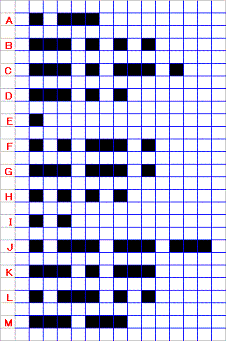
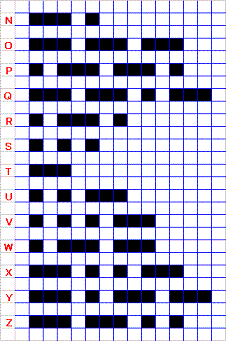
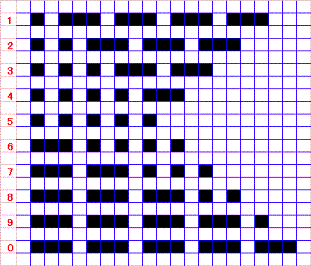
This table also shows that the recommended ratio of dots to dashes is 1:3, with a spacing of one dot between each dash. It is best to have a gap of 7 dots after each word ends. The image below clearly illustrates the timing of CQ DX's dots and dashes in CW (Image source: A1Club).

II. Q-language
In CW communication, Q-phrases are essential. While many Q-phrases are provided in A/B exercises, it is still necessary to learn more and be able to use them fluently in CW communication. Below is a table of commonly used Q-phrases in CW:
| Q Concise Language | Questioner | Answer provided |
|---|
| QRA | What is your station call sign? | My station callsign is… |
| QRG | Could you please tell me the exact frequency? | The accurate frequency is... kHz/MHz |
| QRH | Will your frequency change? | My frequency will change. |
| QRI | How does my voice sound? | Your pitch sounds like a 1 (good), 2 (unstable), or 3 (bad). |
| QRK | How does the clarity sound to you? | Your signal sounds bad.5(Very clear) |
| QRL | Are they using this frequency? / Is this frequency being used? | They are using this frequency / This frequency is being used. |
| QRM | Is the communication being interfered with (intentionally)? | The signal from 通联 was interfered with, resulting in a strength of 1 (weak).5(Very serious) |
| QRN | Did Zhonglian receive interference from Tian's equipment? | The signal from Zhonglian was affected by interference from a strong radio source, with an intensity of 1 (weak).5(Very serious) |
| QRNN | | The communication system was severely affected by electromagnetic interference (I GOT HVY QRNN). |
| QRO | Do I need to increase the power? | Please increase your power. |
| QRP | Do I need to reduce the power? | Please reduce your power / I am in low-power transmission mode. |
| QRQ | Do I need to increase my transmission speed? | Please increase your transmission speed (to XX WpM). |
| QRS | Should I slow down my transmission rate? | Please reduce your transmission speed (to XX WpM). |
| QRT | Should we terminate the launch? | Please cease firing. |
| QRU | Is there anything else you would like to tell me? | I don't have anything more to tell you. |
| QRV | Are you ready? | I am ready. |
| QRW | Do I need to remind you that you're operating at…? kHz/MHz? | Please remind me… I'm using … kHz/MHz. |
| QRX | When will you call me again? | I will contact you again at … (at … kHz/MHz) |
| QRY | When is it my turn to communicate with you? | Your order is… |
| QRZ | Who is calling me? | …Calling you (at … kHz/MHz) |
| QSA | How strong is my signal? | Your signal strength is 1 (very weak).5(Very strong) |
| QSB | Is my signal weak? | Your signal is weak. |
| QSD | Is my signal weak? / Has my signal been interrupted? | Your signal is experiencing interference / Your signal has been cut off. |
| QSL | Could you send me a QSL card? | I will send you a QSL card / I have fully understood the content you are sending. |
| QSO | Can you communicate with…? | I can communicate with… |
| QSY | Is it necessary to switch to a different frequency for communication? | Please switch to … kHz/MHz for communication. |
| QTH | What is your location? | My location is… |
| QTR | What is the exact time now? | The current specific time is... |
In addition, you may encounter some strange and unusual Q codes, such as QLZ (operator is lazy) and QOD (please switch to another language code to continue communication).
III. CW Abbreviations
This section essentially cannot be avoided within CW Tonglian, and there is a significant amount of information to understand. It will continue to be presented in tabular format.
| CW abbreviations | |
|---|
| | Featuring<>The abbreviations indicate sending without gaps. |
| ABT | About | Approximately |
| ADR / ADS | Address | Address |
| AF | Africa | CQ AF refers to calling African Radio. |
| AGN | Again | Once again |
| ANI | Any | |
| ANS | Answer | |
| ANT | Antenna | Antenna |
| <AR> | Transmission complete. | Initially, this indicated that the transmission was complete. Later, within ComNet, it indicates that you are currently communicating with a specified radio station, and your transmitted content has ended. |
| AS | Wait | Please wait. |
| B4 | Before | QSO B4 indicates that a previous communication has already taken place. |
| BCK | Back | |
| BCNU | See you soon. | I hope to see you again. |
| BCSE | Because | Because |
| BD | Bad | |
| BK | Break | During the competition, use brief communication.<u>BK</u>Switch quickly between receiving and transmitting without re-transmitting the call sign. |
| BN | Been | |
| <BT> | | As a delimiter during a launch, indicating that the subsequent content is independent of the preceding text. Please note: Launch repeatedly.<BT>And their impoliteness. |
| BTH | Both | |
| BTR | Better | |
| BTU | Back to you | |
| BTW | By the way | By the way |
| BUG | Semi-automatic key | Stink bug key |
| BURO | Bureau | QSL card, typically used for QSL via Buro |
| C | Yes / Correct | Affirmative response |
| CBA | Phone number and address | Address in the phone book (typically used for contacts with whom you have a personal relationship) |
| CFM | Confirm | Confirmed |
| CK | Check | |
| CKT | Circuit | |
| CL | Closing | About to shut down |
| CLD | Called | I have already called. |
| CLG | Calling | Calling... |
| CLR | Clear | The signal is very clear / The weather is sunny. |
| CMG | Coming | |
| CNT | Cannot | Impossible |
| CONDX | Condition | Propagation status |
| CP | | Typically, this involves calling two or more specific radio stations (a very rare usage). |
| CPI (CPY) | Copy | Complete copy of the contents |
| CQ | Contacting any station | Broadcasting to other radio stations, typically CQing two or three times, has been common practice. However, there have also been instances where a station has CQed multiple times (e.g., twenty or thirty times) before transmitting its own call sign. |
| CRD | Card | QSL card |
| CSE | Because | (Instructions for use are the same as those for BCSE and CUZ) |
| CU | Goodbye | Repeat (typically used at the end of a communication) |
| CUD | Could | could be abbreviated |
| CUL | Talk to you later | I'll see you later. |
| CUZ | Because | (Instructions for use are the same as those for BCSE and CSE) |
| CW | Continuous wave | |
| DE | From / This is | This is (originally in French): |
| DO | | The written version |
| DoP | Dipole | Dipole antenna |
| DSW | Goodbye | Goodbye in Russian, and "Ciao" can also be used as a farewell to Europe. |
| DX | Distance | Derived from "Distance", it indicates long-range communication or abnormal propagation. |
| ES | and | |
| EU | Europe | CQ EU represents a call to European radio stations. |
| EYE | I | Subject: "I"(I)as an alternative |
| FB | Excellent business | Good (appreciation) |
| FER | For | For example, to shorten it, I replaced three "O"s with a single "E". |
| FM or FRM | From | From |
| FREQ | Frequency | Frequency |
| GA | Good afternoon, or Proceed. | "Good afternoon" or "Please continue" |
| GB | Goodbye or God bless | Goodbye |
| GD | Good day / Good morning | A great day. |
| GE | Good evening | Good evening / Good afternoon |
| GESS | Guess | In spoken language, "I guess/I think" |
| GLD | Glad | I am pleased to |
| GM | Good morning | Good morning |
| GN | Good night | Good night |
| GND | Ground | Grounding |
| GP | Ground plane | Ground-plane antenna |
| GS | Green stamp | One way to refer to US dollar banknotes. |
| GUD | Good | Great, good. |
| GV | Give | |
| GVG | Giving | |
| <HH> | Error during transmission | Correction symbols in English Tonglian |
| HI | The telegraph's laughter | Laughter represented using CW (Morse code) |
| HNY | Happy New Year | Happy New Year |
| HPE | Hope | |
| HQ | Headquarters | Headquarters |
| HR | Here / Hear / Hour | Here / I heard / hour |
| HRD | Heard | The past tense I heard |
| HRS | Hours | |
| HV (HVE) | Have | |
| HVG | Having | |
| HVY | Heavy | |
| HW (?) | How or How Copy | |
| INFO | Information | |
| K | Invitation to Broadcast | After sending one message, invite others to send more. |
| <KN> | Invitation to Broadcast | Similarly, after sending a message, invite the other person to send one as well. |
| LID | An unskilled operator | Terrible operator |
| LIL (LTL) | Little | |
| LNG | Long | |
| LP | Long path | Longitudinal propagation |
| LSN | Listen | |
| LTL (LIL) | Little | |
| LTR | Letter or later | |
| LV | Leave | |
| LVG | Leaving | |
| LW | Long wire or long wave | |
| MA | Milliampers | |
| MGR | Manager | |
| MI | My | Abbreviation for "my" |
| MICRO | microcomputer | |
| MM | Mobile maritime | Mobile maritime transmission |
| MNI | many | abbreviation for many |
| MOM | Moment | |
| MSG | Message | |
| MTRS | meters | Rice |
| MULT | Multiplier | |
| NA | North America | CQ NA refers to calling North American radio stations. |
| NCS | Network Control Station | |
| ND | No way. | Nothing to do. |
| NIL | I have absolutely nothing to offer. | There's nothing more to say. |
| NR | Number, Approximately | Number |
| NITE | Night | Good night = GN |
| NW | Now | Currently |
| OK | Correct | Correct |
| OM | Elderly man | Old friend |
| OP or OPR | Operator | Operator |
| OW | Elderly woman | |
| PSE | Please | Request: Please |
| PSED | Pleased | |
| PWR | Power | Power |
| R | Roger | Fully understand |
| Received or RCD | Received | Received |
| RCVR | Receiver | Receiver |
| REPT / RPT | Report | Report |
| RIG | Station Equipment | Equipment |
| RPT / REPT | Repeat | Repeat |
| RST | Signal Report | Readability: 1-5 / Signal Strength: 1-5 / Tone: 1-9 |
| RTTY | Radio Teletype | |
| RX | Receiver | Receiver |
| SASE | Envelop with self-addressing and pre-stamped | Envelopes with the sender's address and postage |
| Signal(s) | Signal(s) | Signal |
| SK | Silent Key | Deceased |
| SKED | Schedule | Plan |
| SN | Soon | Recently |
| SND | Sound | |
| SP | Short Path | |
| SRI | Sorry | Sorry, but I need to know what they hope you will do next. |
| STN | Station | |
| SU | Goodbye | Another way to write "CU" |
| SUM | Some | |
| SVC | Service | Services |
| SWL | Radio enthusiast | |
| T | Zero | |
| TEMP | Temperature | Temperature |
| TEST | Testing or Competition | Currently being tested or in a competition. |
| TFC | Traffic | |
| TKS(TNX) | Thanks | Thank you. |
| TKU(TU) | Thank you | Thank you. |
| TMW | Tomorrow | Tomorrow |
| TNX(TKS) | Thanks | Thank you. |
| TRBL | Trouble | |
| TRE | There | |
| TRIX | Tricks | |
| TRX | Transceiver | Transceiver |
| TT | That | |
| TTS | That is | |
| TU(TKU) | Thank you | Thank you. |
| TX | Transmitter | Transmitter |
| TXT | Text | |
| U | You | |
| UR | Your or You are | You |
| URS | Yours | Yours |
| <VA>(<SK>) | Transmission complete. | The termination symbol for Tonglian |
| VERT | Vertical antenna | The collective term for vertical antennas. |
| VFB | Excellent business. | Excellent! |
| VFO | VFO | Variable frequency oscillator |
| VVV | | Adjusted symbols (or indicating today's sunny weather) |
| VY | Very | Very |
| WKD | Worked | And… I communicated with Tonglian. |
| WKG | Working | Currently communicating with… Tonglian. |
| WID | With | And |
| WL | Will, Well | "Good" or "going to" |
| WPM | Words per minute | Words per minute, CW transmission speed unit |
| WRK | Work | |
| WTS | watts | Units of power |
| WUD | Would | abbreviation for would |
| WW | Worldwide | Global scale |
| WX | Weather | Weather |
| XCVR | Transceiver | Transceiver |
| XMAS | Christmas | Christmas |
| XMTR | Transmitter | Transmitter |
| XTAL | Crystal | Crystal oscillator |
| XYL | Wife | Wife (also previously used as a term for the female OP) |
| YL | Young woman | Female OP |
| YF | Wife | Wife |
| YTD | Yesterday | Yesterday |
| Z | Zulu | Coordinated Universal Time |
| 30 | I don't have anything else to send. | And QRU, NIL have the same meaning. |
| 55 | Optimal success | Best wishes for success. |
| 73 | Best regards | Best wishes |
| 77 | May CW endure forever. | CW forever! |
| 88 | Love & Kiss | Best wishes to female HAMs. |
| 72 | Best regards | Best wishes for your QRP radio operation. |
| 161 | Best regards to you and your XYL. | 73 + 88 = 161, best wishes to all HAMs with families. |
| ? | Question Mark / I repeat | Typically used to indicate a question or to separate my information. |
IV. Unified Format
Since we've covered so much information about common communication formats, the most important thing is still the format itself. I previously posted a CW communication format in a forum thread related to learning CW, and I want to reiterate it now.
I typically categorize CW communication into three types: fast communication, competition communication, and daily communication (which may include a comprehensive set).
Fast communication
In typical long-range communication scenarios, such as when using a simplex radio or communicating with satellites passing overhead, we typically use short messages in the following formats:
Assuming I successfully achieved compliance with P5 regulations and became part of the "Far East Base" (Fog), BI8EUY would come to assist.
CQ BH6BEZ/P5 (UP X)
>BI8EUY
BI8EUY 5NN
>R(CFM) 5NN TU
TU CQ BH6BEZ/P5
In this example, as the expedition station, I don't need to stay on CQ for a long time. Just one CQ and one call sign are sufficient (reducing communication time and improving efficiency). BI8EUY only needs to send its own call sign, and after I fully receive it, it will immediately send its call sign + RST, and the other party will then respond with "R(CFM) Simply entering "5NN TU" will complete the connection.
Please note! In your final signal report reply, it is best to include the abbreviations "R" or "CFM" to indicate that you have fully received and copied the message. Otherwise, you may be marked as "Not in Log!!!" (Thank you to BG4UVR and BG2QMO for the reminder).
Similarly, on a terrestrial satellite system, we only need to exchange call signs and signal reports simply. For example,
CQ SAT BH6BEZ
>BH6BEZ BI8EUY 5NN
BI8EUY 5NN TU
>TU
CQ SAT BH6BEZ
This allows for a single connection.
Competition details
In various competitions, there are also specific communication methods, which typically involve RST+Exch, for example:
[CQWW DX CW]
// Exchange: CQ Zone
CQ JA3YBK TEST
>BH6BEZ 5NN 24
BH6BEZ 5NN 23
>(RR) TU
CQ JA3YBK TEST
[ARRL DX CW]
/*
W/VE: RST + (state/province)
non-W/VE: RST + power
*/
CQ K7NJ TEST
>BH6BEZ
BH6BEZ 5NN UT
>R 5NN 1TT TU
NR?
>R 5NN 1TT TU
TU CQ K7NJ TEST
[A1Club AWT]
// Exch: Members: RST+Name
CQ BH6BEZ AWT(TEST)
>JJ1FXF 5NN HIRO
JJ1FXF 5NN IZUMI TU
>TU
CQ BH6BEZ AWT(TEST)
Essentially, these contests involve a short CQ call + signal + TEST transmission, followed by waiting for someone to send their own call sign. Once they receive it, you immediately reply with the other person's call sign + RST + Exch. After the other party receives and confirms their RST + Exch, they send TU to end the connection, and then continue CQ testing. In the example above, ARRL DX's K7NJ asks me "NR?", indicating that he didn't fully receive my Exch and needs me to re-send it, after which the connection is ended.
Of course, there are times when the other party's RST or Exch cannot be copied, and it is necessary to send "NIL" to indicate that they are not in your log, so that they can first connect with others.
Daily communication
A common scenario is a routine contact, which typically involves exchanging RST and the callsign. However, some people will also send you their NAME, QTH (location), and WX (weather conditions), which I refer to as a "complete set." See the example below.
CQ CQ CQ - BH6BEZ - BH6BEZ - PSE
>(BH6BEZ) DE BI8EUY BI8EUY <KN>
RR DR OM GM/GA/GE UR RST 599 5NN <BT> OP, who is Izumi? Is Izumi a hardware component? <KN>
>R DR OM IZUMI - General Manager/General Assistant/General Engineer <BT> Thank you for the report. <BT> UR RST (ALSO) 599 5NN FB FB <BT> The HR rig is 7300, 73OO, and 73TT. <BT> PWR PWR is 100W 1TTW <BT> ANT ANT IS EFHW EFHW HW? <KN>
Okay, okay, Dr. OM, thank you for the information. All CPI. <BT> The HR rig is 705 7T5. <BT> PWR 10W 1TW <BT> ANT IS GP GP <BT> Location: Hefei, Hefei <BT> OK BI8EUY DE BH6BEZ DR OM TNX FB (CW) QSO ES HPE CU AGN <BT> GL GL 88 88 TU TU <SK> EE
>RR BH6BEZ DE BI8EUY DR OM IZUMI TNX FB QSO ES GL 88 88 TU TU E E
E CQ CQ CQ BH6BEZ BH6BEZ PSE K
This was a simple CW exchange where we shared information about our equipment, power levels, and antenna configurations, essentially having a straightforward conversation.
First, I performed a CQ on the frequency, and BI8EUY indicated that he was responding to me. Then, "<KN>"He asked me to reply.
When the other party provides<KN>After that, don't use each other's call signs anymore!<KN>This confirms that I have received your reply after understanding both parties' identities! (JO3HPM specifically emailed me to remind me to differentiate between them.<KN>(How to use)
Insert a topic here that people might add to after completing many communications.<BK>Let the other party respond; this is not standard usage. 1 according to<BK>Its definition can be used in brief or competitive communications.<BK>As a transmit/receive switching table, it is recommended to replace it with K or<KN>
As shown in the example above, I first provided BI8EUY with my signal report, then gave my own name, IZUMI, and finally asked HW a question and invited him to respond. BI8EUY also expressed his gratitude for my signal report in his response, continued to send me his signal report, and finally provided me with information about the power output of his equipment.<BT>As an interval table symbol
Basically, this is the typical flow for a daily CW QSO, and now it's time to play MaiMai! 88~ (running away)
 闽ICP备2021006864号-7
 闽公网安备35020602002794号