PA3FWM is a well-known http://websdr.ewi.utwente.nl:8901/ The creator of this, whom I recently saw on his personal website (which has a lot of useful information), has kindly allowed me to repost it for learning purposes!
https://www.pa3fwm.nl/technotes/tn25a-dipole-radiation.html
Which part of the dipole emits the strongest radiation?
Pieter-Tjerk de Boer, PA3FWM pa3fwm@amsat.org
(This is an adapted version of an article I wrote for the Dutch amateur radio magazine Electron, published in March 2021.)
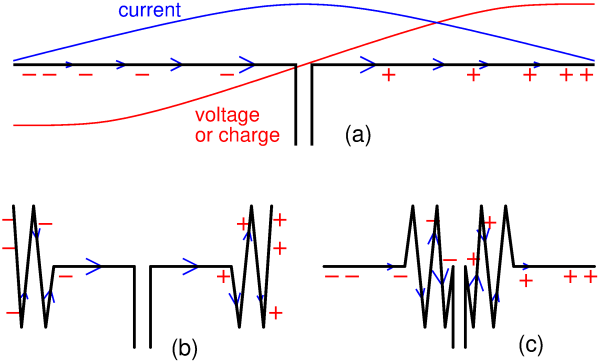
The title might seem like a strange question. However, it is often said that the largest part of the current radiates the most strongly. This leads to the following rule of thumb: if there is not enough space to hang a complete half-wave dipole (Figure (a)), then try to make the center portion as free as possible, while the ends can be hung in a zigzag pattern (Figure (b)). After all, the current is largest in the center (indicated by the blue line and blue arrows), so this part radiates the most strongly and must be free.

Alternatively, you can choose to make the central portion curved and extend the end portions, as shown in Figure (c). The part with the most accumulated charge (indicated in red) will then be free, but this is not particularly important according to experience.
This rule seems a bit strange. Radio waves are electromagnetic waves. Current (at the maximum point in the dipole) generates a magnetic field, while charge (accumulated at the end of the dipole) generates an electric field. Why is that central part more important? Does nature prefer magnetic fields?
No. The principle of experience is correct, but the explanation is a bit nuanced.
The dipole, as a whole, always has an overall neutral charge. Therefore, if the left half carries a negative charge, the right half also carries a positive charge. The total charge is zero, and this results in a zero electric field. We still obtain a non-zero electric field because the positive and negative charges are not at the same location. The further apart the charges are from the dipole, the larger the net electric field becomes. How can we move the charges as far apart as possible? In fact, the best way is to hang the central part straight up, as shown in (b).
In other words, Figure (b) maximizes both the magnetic field (by allowing the largest part of the current within the dipole to be freely suspended) and the electric field (by moving the portion of charge accumulation within the dipole as far away from each dipole as possible).
There is another way to explain this. If a wire moves in a zigzag pattern, the magnetic field within the "zigzag" is opposite to the magnetic field in the "sawtooth" shape, because the current flows back and forth (in the zigzag) and also back and forth (in the sawtooth). Therefore, their magnetic fields largely cancel each other out. However, the electric field of the charges in the "zigzag" and "sawtooth" shapes does not have this problem; they reinforce each other because the charges in both the "zigzag" and "sawtooth" shapes have the same polarity. Thus, a zigzag shape is not a disadvantage for wires that accumulate more charge, but it is a disadvantage for wires with larger currents. This gives us another reason to make the middle part straight and the end part zigzag.