PA3FWM is a well-known http://websdr.ewi.utwente.nl:8901/ The creator of this, whom I recently saw on his personal website (which has a lot of useful information), has kindly allowed me to repost it for learning purposes!
https://www.pa3fwm.nl/technotes/tn09b.html https://www.pa3fwm.nl/technotes/tn13d.html China mainland in 08The primary business in the .3KHz band is marine mobile and marine radio navigation, at 8.3KHz.9KHz's primary business activities are meteorological support, waterborne transportation, and marine radio navigation; it does not have any secondary business.
Signal-to-noise ratio of a digital hobby mode
Pieter-Tjerk de Boer, PA3FWM pa3fwm@amsat.org
(This is an adapted version of an article I wrote for the Dutch amateur radio magazine Electron, published in February 2015.)
According to reports, the reception effectiveness of WSPR signals is 29 dB lower than noise. This means that a signal 800 times weaker than the noise can still be perfectly decoded. Other modes require stronger signals, such as PSK-31, which has a noise level of 7 dB, or weaker signals, such as OPERA-32, which has a noise level of 35 dB. But what do these impressive numbers mean?
Signal-to-noise ratio (SNR) cited in amateur radio mode (SNR) Traditionally, receivers have a bandwidth based on 2500 Hz, because these modes typically use standard SSB receivers, which have IF filters with a width of approximately 2500 Hz. Actual signals are usually much narrower, for example, around 6 Hz in the case of WSPR. Therefore, it's strange to compare the power of a 6 Hz wide signal with the noise power received by a total 2500 Hz wide filter. Measuring the SNR within the actual bandwidth used by the receiver would be more meaningful; however, it may be difficult to determine or define the "true" receive bandwidth.
Professionals use different ways to express SNR, which doesn't require randomly selecting the noise bandwidth. They specify a quantity called Eb/N0. Eb is the energy per bit, and N0 is the power of the 1 Hz noise. Therefore, the denominator of this ratio is equivalent to what hobbyists use, although it's 1 instead of 2500 Hz. However, the key lies in the numerator: hobbyists put the received power there, while professionals use the received energy per bit. For example, suppose we receive a 6 pW signal, which is 6 pJ per second (picojoules), which is sufficient to transmit 2 bits per second. Then Eb = 3 pJ/bit.
Let's consider an example: what would happen if we doubled the speed of WSPR? That is, all bits of the beacon must be transmitted within 1 minute, instead of 2 minutes. Each symbol would last for half the time, or 0.342 seconds, so the frequency (since WSPR is an FSK signal) needs to be twice as high; therefore, the signal width becomes twice as wide. The receiver would need a filter that is twice as wide, which means it would receive twice as much noise, and therefore requires a twice as strong signal to achieve good reception. Using the "amateur mode" with a specified SNR of 2500 Hz bandwidth, the required SNR would double, or increase by 3 dB. If we calculate this in terms of the actual received bandwidth, the required SNR remains constant. So what about Eb/N0? N0 remains constant. Eb also doesn't change, because although the required power is doubled, we also get twice as many bits; therefore, the energy per bit remains the same.
Therefore, Eb/N0 is a measure of modulation techniques (including error correction codes). (FEC)) A very honest and meaningful measure of performance. In fact, Eb/N0 is such a good metric that its fundamental limit can be derived from it. As early as 1948, Claude Shannon mathematically proved that if Eb/N0 is less than -1.59 dB, then regardless of the intelligent modulation, encoding, and signal processing used, it is impossible to transmit bits without errors! (CE Shannon: The Mathematical Theory of Communication, 1948)
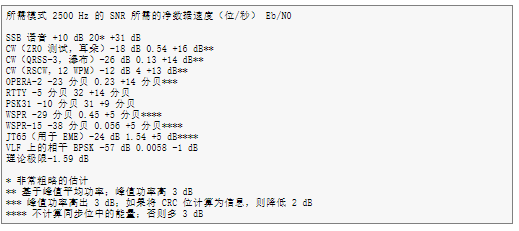
This table compares the required SNR and Eb/N0 for some well-known amateur modes at 2500 Hz. It clearly shows that, due to the large differences in data rates, a mode operating at the lowest SNR may not necessarily be the most effective in terms of Eb/N0.
However, we must be cautious when interpreting the numbers in the table. For most modes, there is no clear distinction between working and non-working states; this transition is gradual. Therefore, professionals always specify the required Eb/N0 for a particular bit error rate. Furthermore, as some footnotes discuss, it is often unclear what people are trying to calculate.
CW (Morse code) appears three times in the table, with the numbers coming from different sources, but they are very consistent regarding Eb/N0. The first CW entry is based on an analysis of ZRO tests conducted by W2RS through Oscar-13 in the 1980s and 1990s, where participants had to reproduce a sequence of digits at a speed of 10 WPM, repeating it three times. This means that the lower bits (W2RS: human's weak signal capability)http://web.archive.org/web/20050207235207/http (来自 http://www.n1bug.net/tech/w2rs/humanear.html)。 The second item is based on ON7YD's experiment with QRSS-3 signals: very slow Morse code, where a single dot lasts for 3 seconds, and is copied from the waterfall display rather than being heard (ON7YD: QRSS3 challenge http://on7yd.strobbe.eu/QRSS/). The third item is based on my attempts to create the best software CW decoder (http://wwwhome.cs.utwente.nl/~pt (deboer/ham/rscw /)。 For most other modes, I used http://www.qsl.net/kp4md/wsprmodes.htm
The SNR values in the document.
However, Eb/N0 is not the ultimate measure: it is simply a measure of channel utilization efficiency, assuming that the channel only adds pure white noise to the signal. In reality, most wireless communication channels also have other impairments, such as impulse noise (e.g., caused by lightning) or variations in signal strength due to fading. Eb/N0 does not indicate how well this mode handles these impairments. For example, comparing PSK31 and WSPR: they require similar Eb/N0 values, but while a brief dropout in PSK31 immediately causes some letters to be lost, WSPR is much less sensitive to this because all the letters are "spread out" over the entire 2-minute transmission.
BPSK on VLF
Over the past few years, some amateur radio enthusiasts have conducted experiments in the Very Low Frequency (VLF) range below 9 kHz. There is no official amateur band in this frequency range, but because frequencies below 8.3 kHz have not been allocated by the ITU, some amateurs have applied for or obtained permission to transmit there. Due to wavelengths exceeding 30 km, any practical amateur antenna would be too small; therefore, efficiency and effective radiated power are very low.
In May 2014, DF6NM and Paul Nicholson in the UK conducted an experiment (which they reported on the RSGB LF mailing list), transmitting a 46-bit message at a frequency of 8270 Hz over a distance of more than 1028 km in just 132 minutes, with an effective transmit power of less than 10 µW. They used BPSK (Binary Phase Shift Keying), which involves flipping the phase of the transmitted signal by 180 degrees to represent 0 and 1. This can be easily implemented using a mechanical relay, as each symbol is transmitted for 30 seconds. Paul Nicholson developed a very powerful error-correcting code for these experiments. (FEC), as well as the software used to decode this code, which extracts signals from noise using a large amount of computation: http://abelian.org/fec/. As shown in the table, the results are very close to the Shannon limit.
However, this technology is practically limited to VLF because it requires a very stable transmission: within these 132 minutes, the signal's phase cannot fluctuate significantly. Furthermore, performing this operation at higher speeds (in higher frequency bands) also leads to increased computational load.
[Note: This technology was also successfully used for transatlantic Very Low Frequency (VLF) transmission prior to the writing and printing of this article; see http://w4dex.com/vlf/8822hz_dec14/]
More reasons for the numbers in the table:
SSB voice data rate: 20 bits/second, from http://storage.sk.uni-bonn.de/Milca/ssv/content/ssv_s143_en.xhtml
CW 10 wpm ZRO test data rate: The ZRO test only produced numerical results, with an average length of 2.04 seconds, each number being 3.3 bits, repeated 3 times, resulting in 0.54 bits/second. SNR and Eb/N0 were based on the "Z8" level within the ZRO test.
CW at 12 wpm, using RSCW and QRSS3: The letters A and Z, along with the numbers 0-9, have a total of 69 characters and 63 hyphens. Therefore, the average character requires 2+(69/36.)2+(63/36.)4 = 12.833 time units. Assuming that all characters have equal probability (random text), then each time unit gives 2log.(36)/12.8333 = 0.403 bits. At 12 WPM, a dot takes 0.1 seconds, so that's 4 bits per second. For QRSS3, with a 3-second dot time, 0.403 / 3 = 0.134 bits per second.
OPERA: Each message consists of 51 bits, with 28 data bits, 4 unused bits, and 19 checksum bits. Since the checksum bits could only be used as a final check, rather than for searching the most likely message (due to the additional FEC overhead), they can be considered as data.
RTTY: 45.45 baud, with a start and stop bit added for each 5-letter character, so only 5 out of every 7 bits contain user information.
WSPR and JT65: Each processes 50 user data bits in 111 seconds, and 72 user data bits in 46.8 seconds. Half of the energy goes into synchronization bits. In other words, without this, people could achieve the same result, but at the cost of extensive searching on the receiver side.
Experimental new digital mode: EbNaut
Pieter-Tjerk de Boer, PA3FWM pa3fwm@amsat.org
(This is an adapted version of an article I wrote for the Dutch amateur radio magazine Electron, published in August 2016.)
Earlier, [11] I wrote about amateur enthusiasts using slow BPSK modulation with strong error correction codes to transmit messages on VLF at low signal levels, which nearly reached the Shannon limit. The effective radiated power was less than 10 microwatts, and a signal of 8.27 kHz traveling from Germany to the UK over approximately 1000 kilometers, and also crossing the Atlantic in December 2014 using about 150 microwatts.
Subsequently, Paul Nicholson further developed this technology and implemented it in software that could run on any PC, creating a new digital mode called EbNaut [7] for amateur enthusiasts. However, it was not a true standard QSO mode. It required a propagation path that would not experience significant phase shifts throughout the transmission, effectively limiting it to LF and VLF frequencies. The receiver needed substantial computing power. Most importantly, the receiver had to accurately know the expected transmission frequency, time, and parameters. The software could not automatically search for signals, and the signals were often too weak to be seen on equipment such as waterfall displays. This was a deliberate design choice; otherwise, some of the transmitted energy would be "wasted" in helping the receiver identify and synchronize with the signal, which would then no longer be available for actual communication. Therefore, EbNaut is primarily used for experimentation and testing, coordinated through the rsgb_lf_group email list.
Reference:
[7] http://www.abelian.org/ebnaut/
[11] PA3FWM: Signal-to-noise ratio for digital amateur mode. Electronics, February 2015; also available on this website.
 闽ICP备2021006864号-7
 闽公网安备35020602002794号